Here are a answers to the most common questions we get asked, but if you have a specific question that you can not see the anser to, please contact us and we will reply promptly.
Read our handy UPN Freight Preparation Guide.
If you are unsure please feel free to contact us for advice 01792 464806
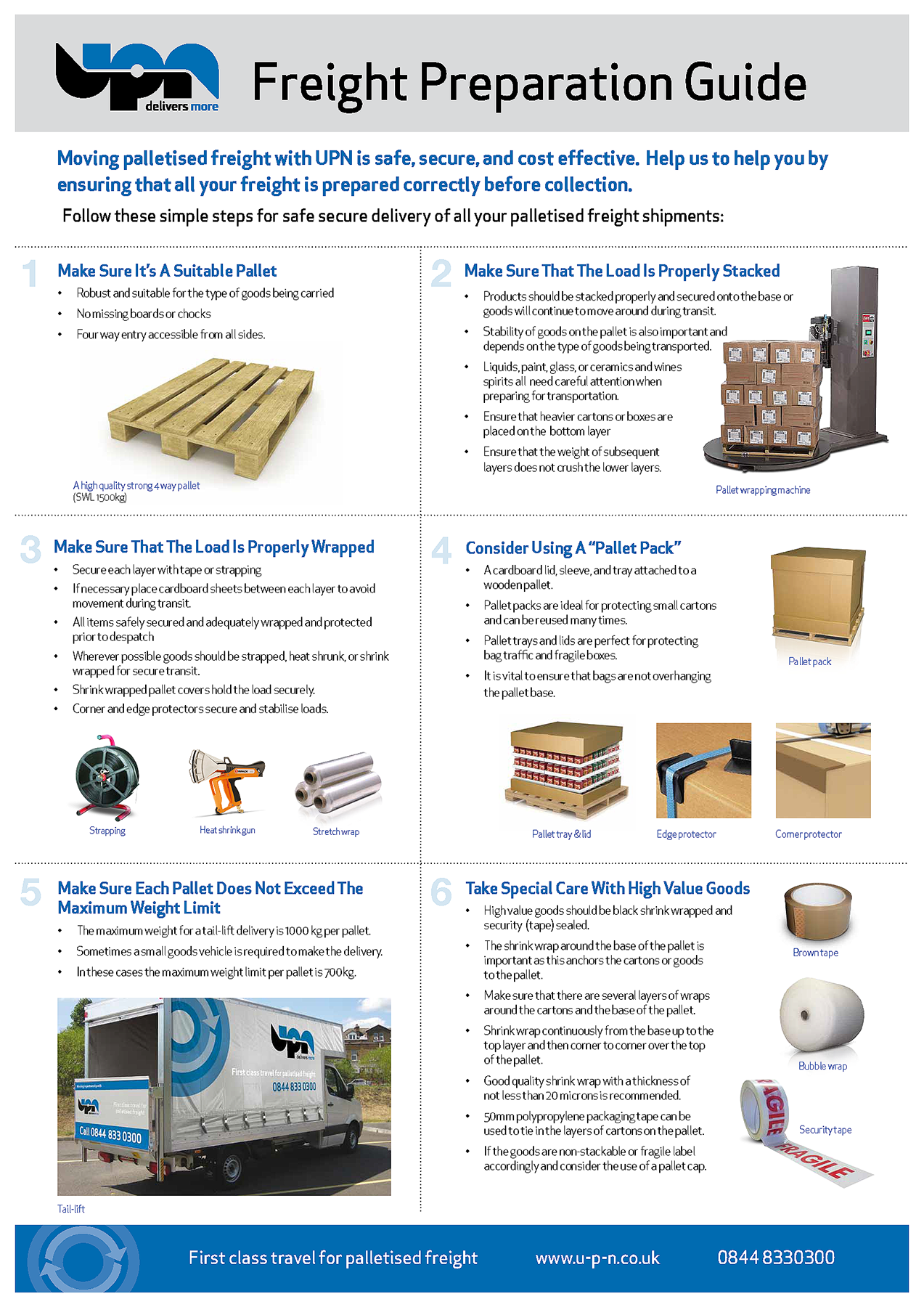
Pallets can be found lying around in many places – they are quite easy to scrounge. Of course you must ask permission first. Make sure the pallet is in good condition and looks like the example in the photo.
You must make sure goods are secured properly. If not the driver has every right to refuse to carry it. Not only will your goods be damaged but a badly packed pallet can also damage other people’s. The standard way is to use shrink wrap – basically strong cling film which can be ordered from us. You can also use rope or straps. You could even screw a wooden crate to the pallet but make sure the screws don’t project. Remember pallets are often loaded in the rain so make sure they are covered.
It is amazing the sort of stuff we see on pallets – everything from empty coffins(vertical) to kitchen sinks – even a complete bathroom suite with clever packing. Pallets can hold a lot of stuff – one pallet can easily fill the back of a small van or a large people carrier. Pallets are big enough and strong enough to even carry over a ton of bricks or an AGA type cooker.
Please make sure ALL oils and other liquids are drained. If YOUR pallet leaks onto other people’s you will be liable for the damage caused. This is vitally important!
It is important to make sure that the lorry will fit down your road BEFORE you request a collection/delivery. The smallest lorries used are 7.5 tons. They all carry a tail lift so it doesn’t matter if you don’t have a forklift.
Correct packaging is the most important thing you can do. Yes it takes a bit of time and effort but a few extra minutes makes all the difference.
Use plenty of bubble wrap - polychips - shredded paper etc and use a good strong box.
Make sure nothing is touching the sides of the box.
Parcels are subject to a lot of handling but as long as you have packed it properly then it doesn't matter. Assume your parcel may be dropped and pack it accordingly.
If you are shipping something large consider using our pallet service.
This is basically a hydraulic platform that will lift a pallet on a pallet truck from ground level up to the back of the lorry. This is ideal for people who don’t have access to a forklift. Note a tail lift will only lift a maximum of 1000kg.
All lorries carry a pallet truck for loading. Please remember that when they are carrying a pallet they will ONLY work on smooth and fairly level ground – concrete or tarmac are best.
Our drivers are very busy. They can not wait for a pallet to be made ready. Of course a bit of common sense will always apply.
The price paid is for one collection/delivery attempt only. Lorries are not cheap to run so if the pallet is not available the charge will still apply.
It is important to make sure that the pallet service you request is the one you pay for. If you mistakenly order a standard pallet when it is a large one additional costs and fees will apply.
If you are sending goods to the EU, you will be required to complete a 'Customs Details' form before finalising your booking. The information provided in the form will be used to generate your Commercial Invoice. Once booked, you will need to attach your Commercial invoice to your order. You will now also have to include HS Code information.
Prior to January 1st 2021, Customers sending parcels to EU from the UK would need to pay 20% VAT on all transactions.
From January 1st 2021, Customers will no longer be required to pay VAT on their transactions for parcels going to the EU.
Customs support has a great guide on how to get an EORI number in your specific country, please check their website for more information - customssupport.com
Tariff codes, such as the Harmonised System (HS), are used in international trade to identify goods.
From December 22nd, HS codes will be required for all parcels being shipped to the EU from the UK.
This change will require customers to complete an additional, straightforward step in the order process.
Yes. Goods now passing from the UK to the EU (and vice versa) will be treated as imports and exports. As such, specific documentation will need to be provided alongside goods to clear custom borders.
Yes. Goods entering the UK will be charged Import VAT and Import Duty. Goods leaving the UK for the EU will be charged Import Duty & Import VAT at EU-set rates. The recipient will be liable for these.
From January 1st 2021, customers sending parcels to Northern Ireland from Mainland UK will still be required to pay 20% VAT on all transactions.
Goods passing from Mainland UK to Northern Ireland will be treated as exports and will be liable for duties and taxes. The recipient will be liable for paying these. Specific documentation will need to be provided to clear customs borders. Tariff Codes such as Harmonised System (HS) or Commodity Codes will be required to help custom officials identify goods when going over the border.
In the early days, post January 1st 2021, it is highly likely that there will be long delays at all UK ports.
Yes, Northern Ireland, Jersey and Guernsey will now require a commercial invoice.
International food shipping restrictions are different for business and individual shippers. Read below the general regulations for sending food items overseas by courier or mail, but bear in mind that you should additionally comply with the local legislation when shipping such products.
Food shipping for Businesses
Licensed companies working in the consumer products sector can ship all types of food internationally, provided they comply with the destination country’s safety, packaging, labelling, and import regulations. They must also have all the necessary certificates and pack food items properly for shipping with authorised transporters only. They must also fulfil the criteria for exporting such type of goods and possess the necessary international certifications.
Food Shipping for Individuals
Shipping food items internationally between individuals is much trickier because most courier companies consider these items restricted for shipping*. The main reason for doing so is that food items often cause leakage, damage to parcels, and have short expiration dates. In addition, the person who decides to ship food internationally must also comply with all the restrictions imposed by the exporting and importing countries, as some food compounds or additives may be prohibited in specific destinations.
That being said, when sending food overseas through the mail, customers may find it easier to send canned and non-perishable food items. Some transporters may also accept vacuum-sealed products as they offer better protection. We strongly recommend avoiding shipping any food item that requires a temperature-controlled environment, as the standard shipping alternatives will not satisfy the necessary conditions.
* Please note there may be additional fees we would need to charge due to using specialised carriers.
This may sound complicated, but your shipment can still be done and we can help!
When packing foods for international shipping, consider that:
Following the steps above we are happy to get your food shipments moving. If you want any advice, please do not hesitate to get in touch.
Please be aware of manual handling procedures for drivers when collecting or delivering goods. Any goods deemed not subject to Health and Safety Standards, additional Handling Fees may be charged.
There is a chance Special Handling Fees may be incurred, if your package doesn't fit this maximum:
Size 48 x 40 x 39cm
Weight Maximum 25kg
We can send larger items if we are aware of this in advance. We will then advise on the most suitable packaging and confirm the additional handling fees.
Please click here to use are contact form should you need any advice.
Here is some general information that can be found regarding manual handling HSE Guidance
EVERYTHING ABOUT OUR SPECS
Parcels to UK consumers
Mailbox parcel
Parcel
International Consumers
Parcel
Pallet
INTERNATIONAL PARCEL SIZES
You'll need to provide an accurate weight (in kilograms) and size (in centimetres) for your parcel.
Your parcel can weigh up to 25kg and can be no bigger than 120cm (l) x 80cm (w) x 80cm (h).
The volumetric weight of a parcel is: length x width x height in centimetres (cm) divided by 4000. If your parcel's volumetric weight is more than the actual weight of your parcel then you’ll be charged the volumetric weight price.
All you need to do is enter the correct weight and dimensions of your parcel into our quick quote or booking form and we’ll work out the cost for you.
So remember, in parcel delivery, size and weight matters!
All Express shipments have to be packed or palletized for transport safely. Packaging has to enclose all goods completely. This applies to pallets aswell.
International carriers generally don't accept shipments with more than a total weight of 3000 kg or any measurement exceeding 300 cm.
We recommend to use a pallet or crate for pieces weighing more than 25kg and over the recommended Manual Handling - Size 48 x 40 x 39cm.
Shipments exceeding 70 kg have to be palletized (Euro or disposable pallet) and loaded with loading aid. Please take into consideration that some countries may have different import regulations.
Pallets are part of the shipment and will add into weight determination.
We reserve the right to repalletize shipments that were not handed over properly and invoice them accordingly.
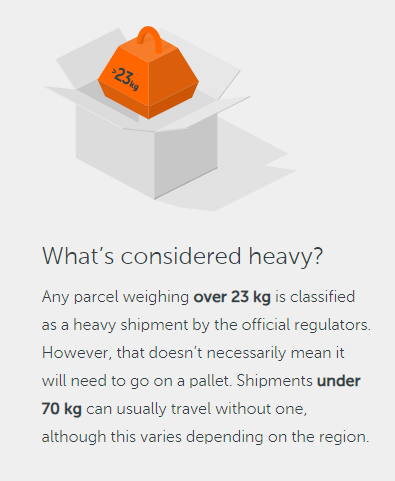
What is Considered Heavy?
Where as we can accept domestic packages up to 70 kg without a pallet, this will also depend on the size of the box. We have to bear in mind manual handling guidelines for Health and Safety purposes.
Under 70kg may still need a pallet to enable the safe movement of the goods for the entire journey.
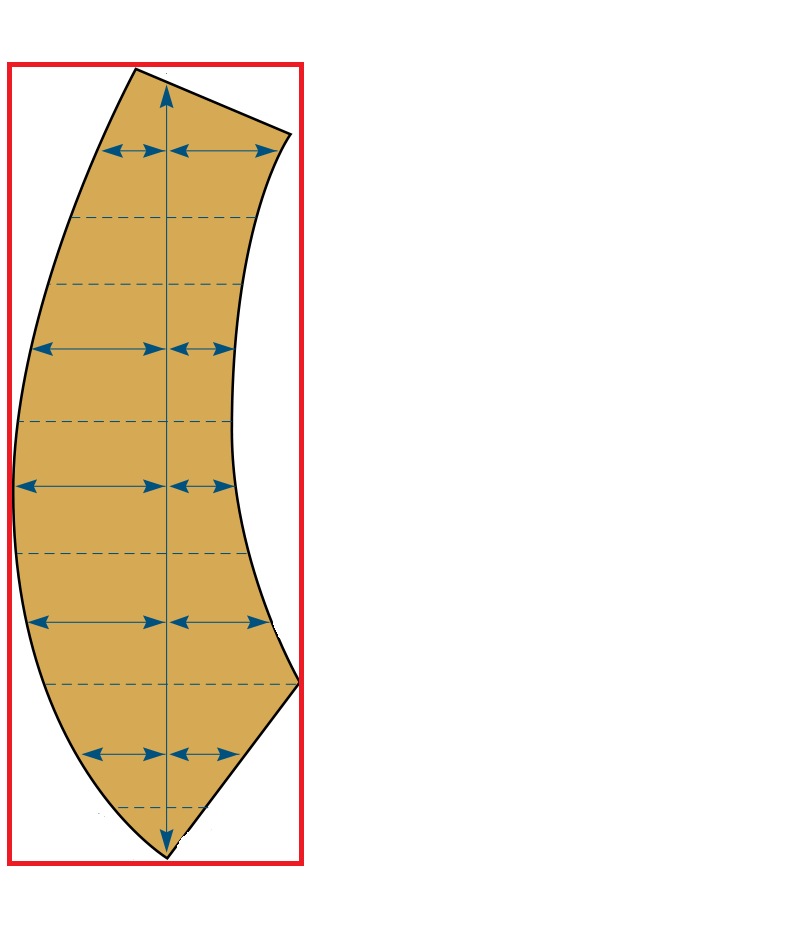
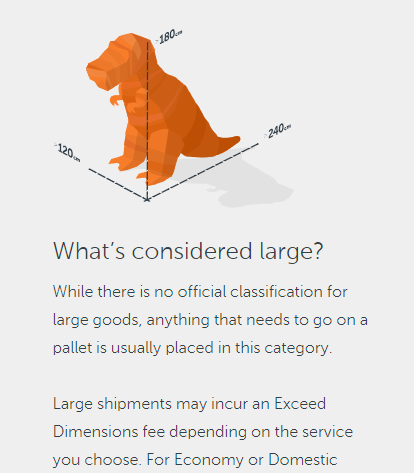
Irregularly shaped products can be tricky to measure accurately but precise measurements are essential for efficient shipping. Even slight variations in measurement can lead to errors and the carrier or forwarder may not leave enough room to fit your cargo in its intended trailer or container; which can in turn lead to delays, additional costs and affecting our customers satisfaction.
The measurements done as your goods travel use 3D cameras and laser scanners to precisely capture an objects’ dimensions. One common strategy you might use is visualizing your irregular freight as though it is in a 3D box.
When you measure, you’re looking for the dimensions of that theoretical box. In plain terms, you’re going to need to use the longest measurement for each one of your dimensions - from the longest, widest and tallest dimensions after packaging.
The image shown below, advises some guidelines to use when measuring difficult shaped items.
What is Considered Large?
Measure the irregular package as shown in the image always use the largest dimensions to get the correct dimensions of the irregular item you are shipping.
Different shipping services have different weight and dimension limits. If you book with inaccurate dimensions, this can lead to an incorrect quote or surcharges at a later stage.
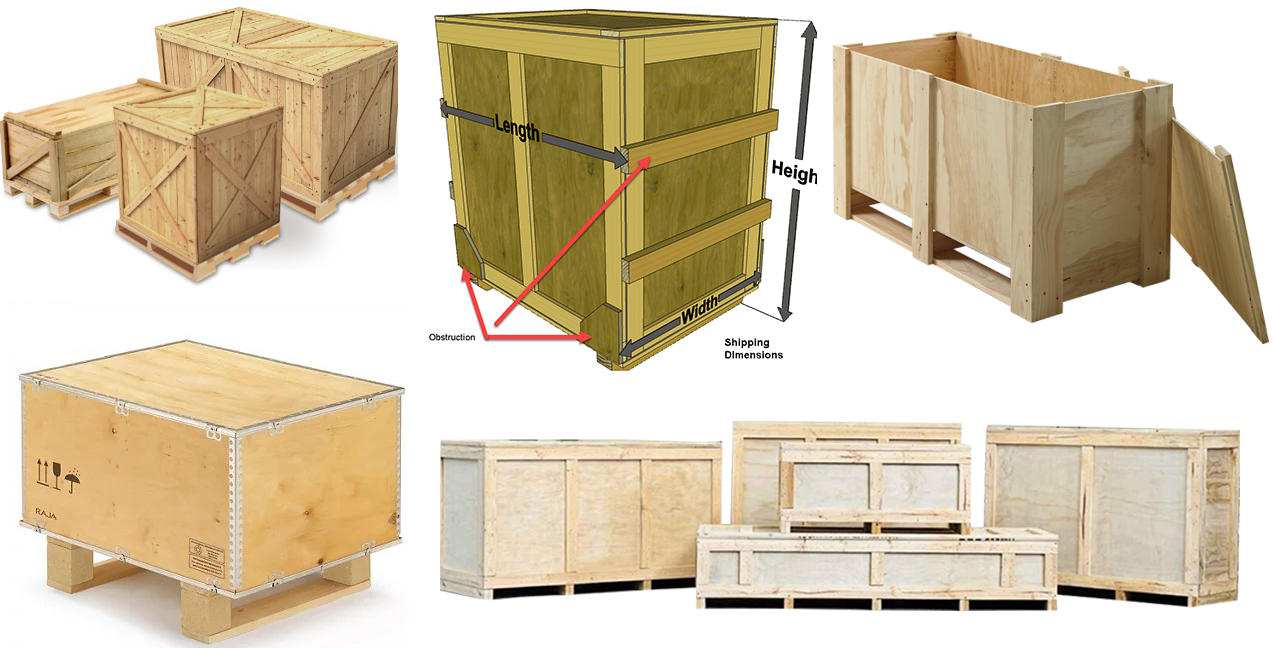
Wooden crates are a great choice when it comes to international shipping. But wooden crates come with their own set of best shipping practices.
Shipping crates are often used for items that are big, bulky and require extra protection from vibration, shock and shifting during transport. They’re also used to ship items smaller items that need an extra level of security, to keep them safe to travel.
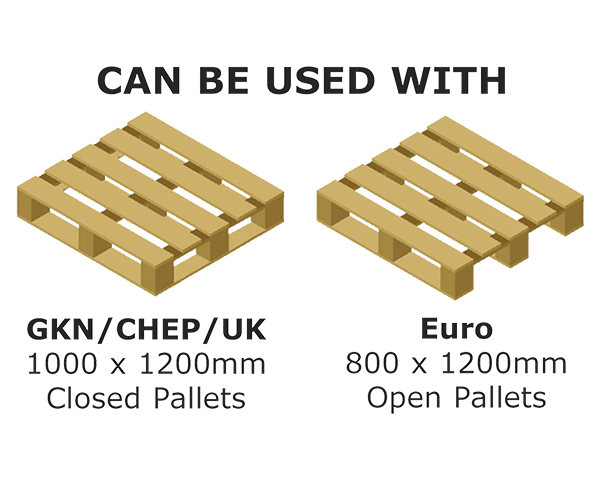
When loading, unloading and stacking your crates, it’s best to use wooden pallets for extra support and security. Pallets can be the same dimensions as your shipping crates, or if your crates are custom made ensure there are openings on the bottom so that loading/offloading at each connection point, can easily be made by forklift or pump truck.
Custom built crates when your item is lighter or smaller than a standard pallet, you must ensure there are pallet style openings on the bottom for forklift purposes. They may be smaller but wooden crates would not be manually handled, a forklift or pump truck would be used. Carriers can add pallets if openings no on the crate and then additional charges would apply.
These crates are designed to hold up under pressure so that you can stack another crate on top without worrying about crushing the items underneath.
Wooden crates are some of the most durable shipping containers to use, carriers are free to stack these containers on top of each other to save on precious cargo space.
It’s always important to label your crates before you ship them overseas. Customs officials will need access certain information as they process your order at the borders. Your label should include information about the destination, who’s shipping the package, what’s inside, how much it weighs and whether the contents are considered fragile.
This information should be clearly labelled on multiple sides of the crate so that the information can be quickly found at customs to avoid shipment delays.
Use accurate measurements after your goods have been packaged, to include weight and size of the crate.
When your crate is on a pallet, and there is no overhang, start and end your measurement at the base of the pallet (to the floor) and end to end.
If your crate is on a pallet, and there IS overhang, measure the longest part of the crate, end to end. If you're just shipping a crate, measure the longest part of the crate, end to end.
When sending to some countries you may need treated wood and a certificate or stamp before the destination country will accept the order. They do an extra inspection at the border to prevent the spread of pests associated with wood packaging. The most common country for this to occur is Australia.
Worldwide shipping using wooden crates are an the ideal choice for many shippers, they do give you the support and strength you need to protect your products as they travel thousands of miles.
Make sure your crates are clean and properly labelled before sending them out for delivery. This ensures your packages won’t be returned to sender, which can cost in more ways than one.
If you need any advice, contact us to start shipping your crated products overseas today!
If you would like to ask us a question that you don't see in our list, please click here to use our contact form, and we will reply to you as soon as possible. If it's a great question we will even add it to our list!
 UK Pallet Collection &
PO Box 676
Swansea
SA1 9NQ
Tel. 01792 464806


© 2009 - 2026 Speedshift UK Ltd | Company Reg. No. 09590353 | VAT Reg. No. 506 2836 00 | Web Design by One Step Design™


